
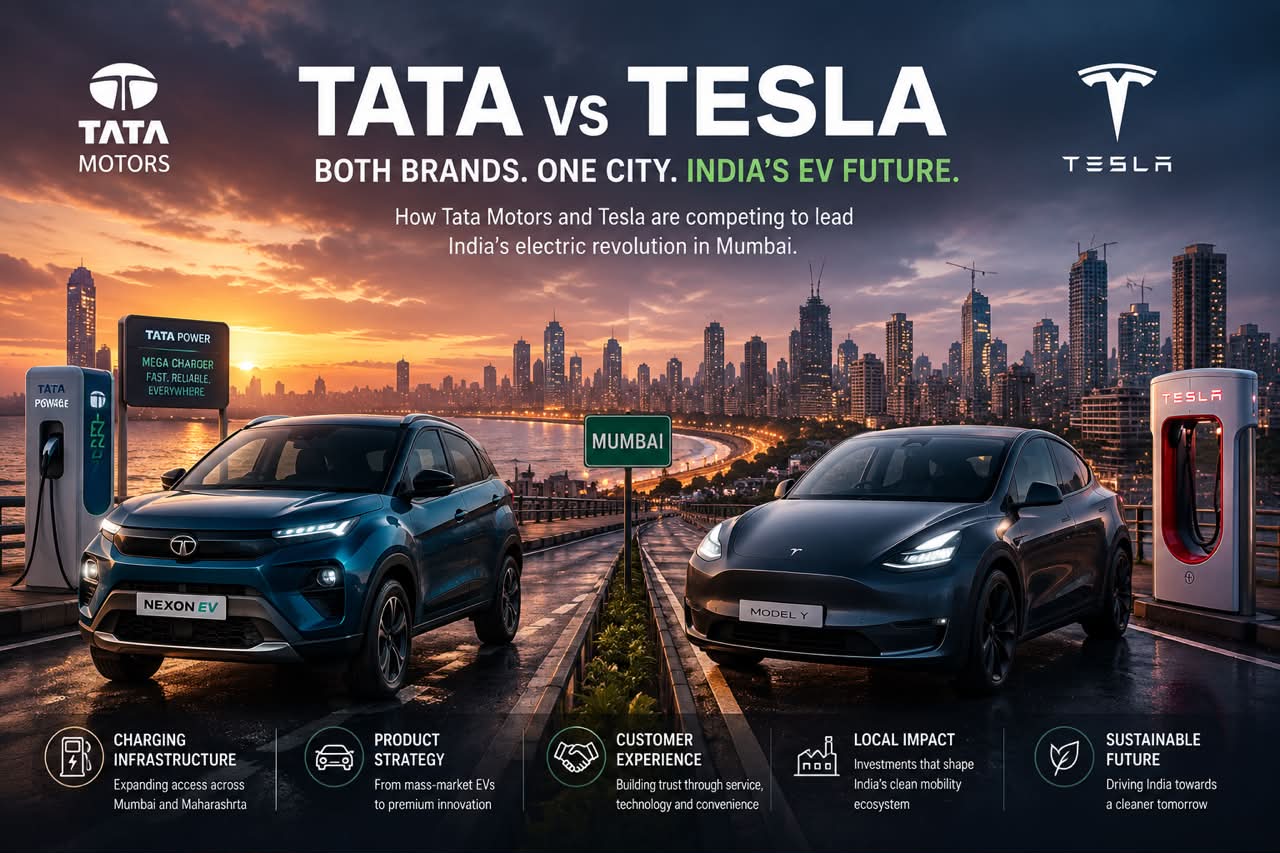
Mumbai is fast emerging as the epicentre of India’s electric vehicle revolution, with both homegrown giant Tata Motors and global EV leader Tesla strengthening their presence in the city. As India pushes toward cleaner mobility, the competition between the two brands is beginning to define what the country’s EV future could look like.
Tata Motors: Strengthening Its Home Advantage
Tata Motors has long been the backbone of India’s electric mobility journey, and Mumbai remains a key market in its expansion strategy. The company continues to push aggressively across multiple EV segments—from entry-level hatchbacks to premium SUVs—aiming to make electric mobility accessible to the mass market.
Recent developments show Tata’s sharper focus on affordability and scale. Models like the Punch EV, Tiago EV, and Nexon EV have helped the brand dominate India’s EV sales charts, while newer launches such as the Curvv EV and Harrier EV signal its move toward a more premium lineup.
In Mumbai specifically, Tata has also invested heavily in charging infrastructure through its Tata Power collaboration, including high-speed MegaCharger hubs and highway fast-charging networks. These initiatives are designed to reduce range anxiety and support long-distance EV adoption across Maharashtra.
At the same time, Tata is evolving its strategy in the premium EV segment, increasingly leaning on global partnerships and platform sharing to accelerate development timelines. This shift reflects the company’s intent to stay ahead in an increasingly competitive EV landscape.
Tesla: Building a Premium EV Footprint in Mumbai
Tesla’s entry into India has brought global attention to Mumbai’s growing importance in the EV sector. The company has positioned the city as its primary gateway to the Indian market, with early sales and deliveries heavily concentrated in Maharashtra.
Tesla’s strategy in Mumbai focuses on the premium segment, targeting high-income buyers with advanced technology, long-range electric vehicles, and a global brand experience. The Model Y has already become the face of its India expansion, reinforcing Tesla’s positioning as a luxury EV brand rather than a mass-market player.
Alongside vehicle sales, Tesla is also expanding its ecosystem approach—combining retail experience centres with service infrastructure and charging access. This mirrors its global model, where software, charging networks, and brand experience play as important a role as the cars themselves.
However, Tesla’s presence in India is still at an early stage, with limited volume compared to established domestic players. Its growth in Mumbai will depend heavily on pricing strategy, local infrastructure expansion, and potential future manufacturing decisions.
Mumbai: The New EV Capital in the Making
Mumbai is uniquely positioned in India’s EV transition. High purchasing power, dense urban mobility needs, and rapid infrastructure development make it the ideal testing ground for both mass-market and premium EV strategies.
For Tata, Mumbai represents scale, trust, and dominance in the affordable EV segment. For Tesla, it represents aspiration, exclusivity, and entry into one of the world’s fastest-growing automotive markets.
Together, these two brands are shaping a dual-speed EV ecosystem in the city—one focused on accessibility, the other on premium innovation.
What This Means for India
The competition between Tata and Tesla in Mumbai reflects a larger shift in India’s automotive future. While Tata is driving widespread adoption through affordability and infrastructure, Tesla is pushing the boundaries of premium electric mobility.
As both companies expand their presence, Mumbai is becoming more than just a market—it is becoming a proving ground for India’s EV ambitions